A veritable truckload of movies with identical names was unearthed recently HERE on SCENIC WRITER’S SHACK. There was unfinished business concerning this topic however, as more research uncovered yet more surprises.
Not only were there films with identical titles to each other but in some cases three or more movies with the same title and yet all with completely different actors, directors and unrelated story-lines. This just had to be laid forth – again.
We begin with a selection of triple-scoopers…
Next, time to make way for the glorious four-scoopers
Alas, the name-alikes listed so far are but mere pretenders to the crown of ‘Most Duplicated Movie Title’ when placed next to the grand prize-winner, SAHARA. This is a film with, to date, no less than six members of the family tree all bearing the same name yet otherwise completely unconnected.
And before we leave the subject of same name movies altogether, here’s a few more identical-twin titles courtesy of readers who alerted me last time… after this oopsie, raspberry ripple double scoop ice-cream break…
Reet Jurvetson was a 19-year-old Canadian woman who was murdered in California in November 1969. Her body remained unidentified for 46 years, until an online mortuary photograph was recognized by her family and friends in 2015.
Prior to her identification Reet’s body had been known simply as “Jane Doe 59”. That’s pictures of her above and below.
On November 16, 1969, a fully-clothed body of a young white female was found by a 15-year old boy who was out bird-watching. The body was discovered in dense brush along Mulholland Drive in Los Angeles, approximately 15-feet down an almost 700-foot ravine. A tree branch had prevented her body from falling the remainder of the way down.
An autopsy determined the female victim had been murdered approximately 24–48 hours prior to the discovery. The victim had defensive wounds on her hands and had been stabbed over 150 times in the neck, chest, and torso, with a penknife, some of the stabbing severing the carotid artery.
A common pocket penknife from the 1960’s.
Based upon the location of the body less than 10 km away from the Manson-ordered Tate-LaBianca murders that had occurred only 3-months prior and the signature ‘over-kill’ methodology, police immediately suspected the crime may have had links to the Manson family.
A woman by the name of Ruby Pearl was a caretaker at the Manson family’s hangout Spahn Ranch during 1969. She told police she had seen a young woman matching Reet Jurvetson’s description several days before at Spahn Ranch with a group of Charles Manson’s followers.
After the body was discovered, Charles Manson was interviewed by police but denied any involvement. He was re-interviewed in 2016, just a year prior to his death, but investigators were unable to uncover any new information from him.
Prosecuting attorney Vincent Bugliosi’s 1974 book HELTER SKELTER suggests Jurvetson – or as she was known then ‘Jane Doe 59’ – might have been present at the death of suspected Manson Family victim John “Zero” Haught who died from a gunshot wound in November, the month Reet Jurvetson was murdered.
Though Haught’s death was determined a suicide, Manson family members were reportedly present, casting considerable doubt on the suicide verdict.
The story of how Jane Doe 59 was eventually identified as 19-year-old Canadian Reet Jurvetson is indeed a fascinating one.
The unidentified body was found only a few weeks after Reet had left Canada and arrived in Canada. For 46 years, Jane Doe 59 had no name and no family had claimed her.
Composite sketches were drawn and distributed at the time but technology did not exist in the 1970’s that would allow nationwide communication and cross-referencing of unidentified bodies. DNA had yet to be discovered as a reliable source of identification. The drawings were rudimentary and hardly identifiable.
It wasn’t until June 2015, friends of Reet’s sister Anne Jurvetson contacted her to tell her they had been searching the National Missing and Unidentified Persons System, a U.S. government database, and found similarities between Reet and a morgue photograph posted on the website.
Anne Jurvetson contacted officials and submitted a DNA sample that was then cross-referenced with a blood sample that had been preserved from a bloody bra. There was a match and Jane Doe 59 finally had a name. It was Reet Jurvetson.
Reet Jurvetson’s murder is examined in-depth in a compelling 2017 two-part documentary entitled MANSON SPEAKS: INSIDE THE MIND OF A MADMAN.
The Los Angeles Police Department have discounted the possibility of Charles Manson or his followers involvement in Reet Jurvetson’s murder. At the same time they cannot rule out a possible connection.
Cold case detectives have named three individuals of interest in the search for Reet’s killer. The first is a Canadian national who had likewise traveled from Montreal to California and who was acquainted with Reet. The second is the first suspect’s room mate. The third is an individual who had lived across the hall from the apartment where Reet Jurvetson had resided at the time of her murder.
The iconic 1980 movie THE SHINING, as well as the appeal of board games are two subjects that have both been previously explored here on the pages of SCENIC WRITER’S SHACK. This time ’round we get to take a look at both at the same time.
Anything of remote significance that happened back in the year 1980 is now commemorating it’s 40th anniversary. That includes the Stanley Kubrick directed master piece of horror THE SHINING starring Jack Nicholson. Naturally there has been a re-issue of the film to coincide with this anniversary, complete with all the requisite extras –
Last year saw the release of what was touted as a sequel to the original film. DR SLEEP, based on Stephen King’s 2013 novel, starred Ewan McGregor and was met with mixed reviews.
Now there’s a thousand piece jigsaw puzzle –
and THE SHINING boardgame. For those who can tolerate overly long ‘unboxing’ videos, the one below unpacks literally everything about this game in minute detail –
In THE SHINING: ESCAPE FROM THE OVERLOOK HOTEL, players assume the roles of Wendy and Danny Torrance as they search for a way out of the hotel.
To escape, players have to contend with puzzles and obstacles along the way, including Jack Torrance, the ax-wielding antagonist immortalized by Jack Nicholson in the 1980 film. By using the psychic ability to “shine” players can unlock clues and solve puzzles that bring them closer to the exit.
The new game is part of the Coded Chronicles game line, and because the objective is to beat the game instead of each other, there’s no limit on how many (or how few) people can play. A full game is estimated to take two hours or more to complete, and this version is recommended for players 17 and older.
On this particular anniversary the story of a struggling writer and his family self-isolating for a winter of productivity only to slowly descend into a murderous nightmare feels especially haunting. Amid the COVID-19 pandemic, people everywhere have been forced to cope with the mental and physical consequences of solitude.
With the monotonous sameness of our 2020 daily rituals insidiously driving us all collectively up the four walls, we can spare a thought for the type of next-level cabin fever laid bare in this all-powerful, almighty cinema classic.
Ps.What’s that? You want a bonus read? Ok, if you insist…
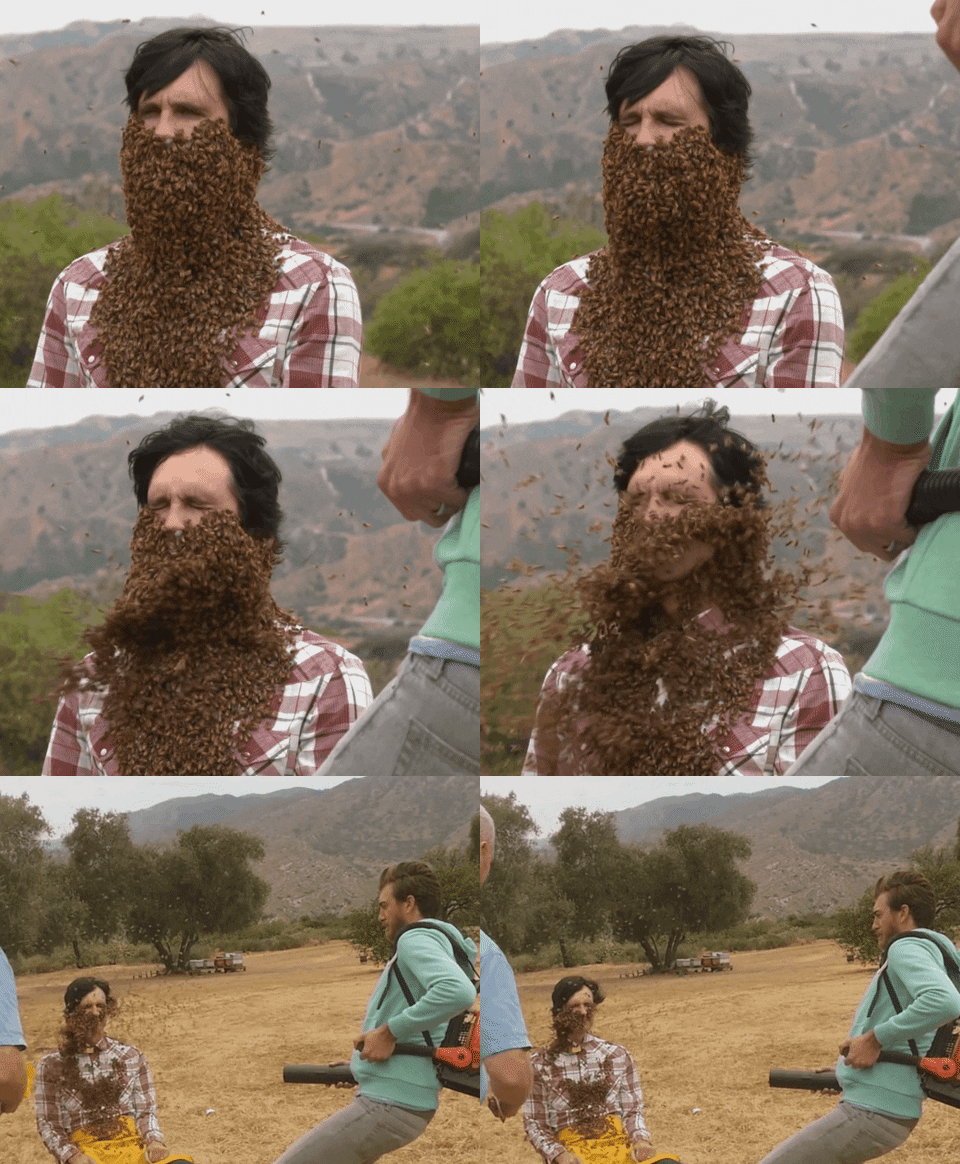
When the swarm of literally tens of thousands of films nesting inside a dedicated movie buff’s head or in a beard-like formation atop of the lower portion of their face reaches critical mass and the buzz becomes too busy to ignore, there’s but one thing to do – not counting inspired uses of a vacuum blower – and that’s compile a Top 100 list.
This particular hive will be organised according to time period – nominating ten beloved films from each of the decades from the 1940’s through to the 2010’s. That will total eighty films, so twenty selections will be included for the 1970’s and 80’s – ‘my‘ decades.
The 1950’s was a decade marked by the post World War 2 boom. The struggle between communism and capitalist systems around the world was in full swing. Politically this time included the assignations of the King of Jordan (1951) and the Presidents of Panama (1955), Nicaragua (1956) and Sri Lanka (1959). The invention of the solar cell and the opening of the world’s first nuclear power plant (in Moscow) took place in this decade.
Academy Award winners for Best Picture during this decade were –
And here are my ten favorite films from this period –
Every frame of these ten films a feast!
Ps. Concise as this list is, naturally there were regrets for the favorite films room couldn’t be found for. Janet Leigh and Tony Curtise’sHOUDINI (1953) was one such film.
The sci-fi/’horror’ classic THE THING FROM ANOTHER WORLD (1951) was another. An omission of downright atomic proportions was inexplicably somehow not managing to find room for Mickey Rooney’s retro-hilarious THE ATOMIC KID (1954). Still wondering how that oversight happened…
Pss. Wanna see another person’s ‘Best Films of the 50’s’ list? Click HERE
Twenty years ago, the world held it’s breath and watched an unfolding drama take place in the Barents Sea amidst the Arctic Ocean off Norway.
Russia’s most powerful, nuclear-powered attack submarine at the time, the KURSK, had suffered two cataclysmic on-board explosions – one so powerful it was detected by seismologists around the globe – and sunk to the bottom of the seabed to the relatively shallow depth of 107 metres below the ocean’s surface.
What is known is that 23 sailors amongst the crew of 118 survived the initial explosions. They lived on for as long as six days after the sub had become a crippled tomb with dwindling on-board oxygen supplies submerged in total darkness and plummeting inner-hull temperatures.
We know this with certainty due to dated, hand-written notes recovered – turns out pen-ink inscribed paper is still readable many months and years after being submerged in seawater – from the bodies of sailors who clung to life as long as they could, huddled together in the still intact, but slowly leaking and filling ninth compartment of the stricken Oscar 2 class submarine.
I’ve watched the 2018, Colin Firth-starring movie KURSK – re-titled THE COMMAND for it’s U.S release – read the book by journalist Robert Moore the film was based on – and vividly recall following every news and television report of the unfolding tragedy and failed rescue attempts I could gather back in August of 2000.
The book in particular offers up a deluge of revealing details of what went shockingly wrong in both the initial accident and the subsequent botched rescue attempts.
The Kursk was finally raised from the ocean floor in 2001. In a stunning technical achievement, Dutch contracting consortium Mammoet–Smit International succeeded in pulling the 155 metre sub ashore. It was the heaviest object ever lifted from such a depth.
These pictures show what the Kursk looked likeBOTH before and after the disaster.
After a year-long investigation, it was confirmed that torpedo malfunction was to blame. This gave lie to several semi-official rumors at the time about a US sub downing the Kursk, or that it collided with another vessel or an abandoned World War II mine.
The Kursk had taken a decade to design, three years to build and just 135 seconds to destroy. The calamitous ticking time bomb in it’s midst was the HTP 65-67 torpedo (two of them were on-board on the day) that had been loaded into tube number four on the starboard side of the submarine’s bow compartment.
HTP stands for ‘high-test peroxide’ – a concentrated form of hydrogen peroxide (water with an extra oxygen atom). The propulsion system responsible for driving the torpedo through the water at a speed of 30 knots relied on a chemical reaction taking place within the torpedo between HTP and kerosene.
The particular HTP torpedo in tube number four had last been serviced six years previously in 1994. Over the intervening time, deep within it’s casing, corrosion had invisibly begun to weaken gaskets close to the tank that contained the HTP. It was a chemical cocktail waiting to begin a chain reaction once it came into contact with the copper-lined torpedo tube.
Britain had banned the use of HTP torpedos back in 1955 after an explosion on-board the HMS Sidon killed 12 sailors. An exhaustive investigation by the Royal Navy concluded that hydrogen peroxide was too volatile to be stored within the confines of a submarine’s torpedo room.
Never again did a British submarine go to sea with weapons that used HTP. The same could not be said for Russia’s Northern Fleet forty-five years later.
Another feature of the tragedy laid bare in the book is the fateful timeline forever associated with the rescue attempts.
The Kursk sank to the bottom of the ocean bed on August 12, 2000. It was not until five days later on August 17 that a Russian submersible attempted rescue. Despite numerous tries it was unable to create a vacuum seal with the crippled sub’s hatch.
More delays followed during which Russian military leaders and newly elected President Vladimir Putin – who had been in office only three months when the disaster unfolded – debated whether or not to accept International help.
On August 20 British and Norwegian crews arrived at the disaster site in the Barents sea. Finally on August 21 – nine days after the submarine sank – they were granted permission to attempt a hatch opening. When they did they discovered the 9th compartment of the sub – where all the survivors of the initial blasts had gathered – was completely flooded.
It was widely considered had Russia responded more promptly and accepted foreign assistance more readily there would have been a much higher chance of the sailors who survived the initial explosion having been rescued alive.
The original tower ofThe Kursk submarine today serves as a memorial in the Russian port city of Murmansk.
Ps. Can you believe there is now a Kursk video game? Available on PC, Mac, Sony Playstation 4 and Xbox One, the game has been released by a Polish company.
According to the developer, after the first few minutes depicting the explosion, the game should then go on to last at least 10 hours.
Players apparently not only have the opportunity to feel like a member of a submarine crew, but are also able to influence the story through their choices, including moral ones. Decisions made have a significant impact on the ending of the game, of which there are several versions.
When the swarm of literally tens of thousands of films nesting inside a dedicated movie buff’s head reaches critical mass and the buzz becomes too busy to ignore, there’s but one thing to do – compile a top 100 list.
This hive will be organised according to time periods – nominating ten loved films from each of the decades from the 1940’s through to the 2010’s. That will total eighty films, so twenty selections will be included for the 1970’s and 80’s – ‘my‘ decades.
The 1940’s was a decade dominated by World War Two and it’s aftermath. Politically it included the assignations of the Soviet politician Leon Trotsky in 1940 and Indian activist Mahatma Ghandi. Inventions to come from this period includedvelcro, the frisbee and the microwave oven.
Academy Award winners for Best Picture during this decade were –
Here are my ten favorite films from this period –
If you’re of the mind, then every frame of these movies may be regarded as a feast!
I am by no means the first nor will I be the last person to describe British popular science writer and evolutionary biologist Richard Dawkins (1941 – ) as having what might be termed a ‘fierce intellect’.
Indeed, unarguably Richard Dawkins has one of the fiercest.
Back in 1992, when asked the question “What has been the most important invention of the last 2000 years?” he offered the spectroscope – the instrument by which scientists determine the chemical nature of stars and by which mankind has come to know – via the red shift of light from receding galaxies – that the universe is expanding and that it began in a ‘big bang’.
As an emeritus fellow of New College Oxford and a former University of Oxford’s Professor for Public Understanding of Science from 1995 until 2008, Dawkins is an intellectual colossal among mental giants.
I’ve read just two of his many books – THE GOD DELUSION (2006) and THE GREATEST SHOW ON EARTH (2009). Both contained some of the most sustained, masterful chains of reasoning I have ever set eyes and mind upon.
THE GOD DELUSION (2006) has sold well over 3 million copies and been translated into 35 languages. His 2009 book systematically laid out the evidence for evolution with a title that came after someone sent him a t-shirt in the mail that read EVOLUTION: THE GREATEST SHOW ON EARTH – THE ONLY GAME IN TOWN.
The name ‘Richard Dawkins’ entered the collective mind of society’s pop culture some time ago. He was after-all, the person responsible for coining the term ‘meme’ way back in 1976 in his book THE SELFISH GENE.
He has also appeared in a 2008 episode of DOCTOR WHO entitled ‘The Stolen Earth’ as himself. His image and voice appeared also in a dream sequence of a 2013 episode of THE SIMPSONS called ‘Black-eyed, Please’.
In 2012 he had a genus of freshwater fish named after him by a team of Sri Lankan ichthyologists (marine biologists). They conferred the scientific name Dawkinsia.
In case you can’t read it, the smaller man in the Superman cartoon is Saying – “D-d-d-did someone say DEBATE?”
Be sure to listen for the line (voiced by Dawkins himself) – “I’m making Catholic Saint stew!”
Dawkins nominates British geneticist John Maynard Smith (1920 – 2004) as his personal hero and rates English -American intellectual Christopher Hitchens (1949 – 2011) as the finest orator on any subject he’s ever heard.
Richard Dawkins is often credited with the quote “With or without religion, good people can behave well and bad people can do evil; but for good people to do evil – that takes religion”. As much as he might endorse that notion, it was actually American theoretical physicist Steven Weinberg that said those words.
Richard Dawkins has so far produced two autobiographical memoirs. AN APPETITE FOR WONDER was published in 2013. BRIEF CANDLE IN THE DARK was released two years later. I am currently 3/4 of the way through the 2015 volume.
The life of a travelling scientist – having conducted field work and spoken to audiences in a great many parts of the world – along with his single-minded devotion to science and it’s place in our intellectual culture makes for engrossing reading…if you have the mind and leaning for such material.
A couple of anecdotes he shares are definitely worth recounting here, including the time he debated Cardinal George Pell – sentenced to six years jail in 2018 on historical sexual abuse charges but whose conviction was overturned by the High Court of Australia in 2020; he is currently still facing a number of civil law suits filed against him on related matters – on the ABC television program Q & A back in 2012.
As Dawkins tells it, he had been warned in advance that Pell was a ‘bully and a bruiser’ but that he had an almost endearing gift for putting his foot in his mouth. This apparently came to the fore during the sharing of an anecdote from the then Archbishop of Sydney about a time when he had been ‘preparing some English boys…’ and allowed an embarrassing pause to ensue before he completed the sentence ‘… for first communion’, a pause long enough to allow a minority of the audience to laugh suggestively.
This is a two minute excerpt from that debate. It showcases George Pell’s gratuitous error of understanding (though not uncommon) that humans were descended from Neanderthals.
Another highlight was the time he was invited to speak at Randolph Macon College in the state of Virginia in the U.S. The audience had been stacked by a busload of fundamentalist Christian students who had driven down from the nearby private evangelical Liberty ‘University’ (founded by televangelist Jerry Falwell). They all occupied the front row.
According to the passage written in BRIEF CANDLE IN THE DARK, these students all monopolized the question and answer session that followed his presentation, lining up as a ‘congregation’ behind the microphones placed in each aisle.
Everything remained polite until one of the students mentioned that at Liberty University they had on display a dinosaur fossil labelled as being just 3000 years old and that this appeared to dramatically contradict Dawkin’s favored timelines of Earth history.
Dawkins responded by clarifying that fossils are dated by several different radioactive clocks – running at very different speeds – and all independently agree that dinosaurs are no less than 65 million years old.
He went on to add – “If it’s really true the museum at Liberty University has a dinosaur fossil labelled as being 3000 years old, then that is an educational disgrace. It is debauching the whole idea of a university and I would strongly encourage any member of Liberty University who may be here to leave and go to a proper university.
From the Randolph Macon College students this comment got the biggest cheer of the evening.
Intellectual HEAVYWEIGHTS ‘THE SIMPSONS’ weigh in with their own depiction of evolutionary theory.
Amusement is gained in equal measure from Richard Dawkin’s rebuttals of what he refers to as ‘theological gymnastics’ – attempts by Bible-clutching spokespeople and ‘leaders’ to conjure symbolic and preposterously speculative interpretations to non-sensical ‘holy’ ideas from the past.
You know the type. “Of course we don’t literally believe the story of Jonah and the whale. But it is symbolic of Jesus’ death and resurrection. Of course Adam and Eve were not real people. They are terms for life and Earth.”
Hold that thought for a moment, while checking this out-
English scientists James Watson and Francis Crick determined the double-helix structure of DNA – the molecule containing human genes –in 1953.
Though DNA – short for deoxyribonucleic acid – was discovered in 1869, its crucial role in determining genetic inheritance wasn’t demonstrated until 1943.
In the early 1950’s, Watson and Crick were only two of many scientists working on figuring out the structure of DNA.
WARNING : This video containsSUCH terms as ‘molecule’ – ‘nucleus’ – and, most strangely, ‘histones’.
Now return to considering Dawkin’s comparison –
Dawkin’s postulates what it would be like if science worked in a similarly flakey way. “Suppose that future scientists were to find that Watson and Crick were completely wrong and the genetic molecule is not a double helix after all. Ah well, of course nowadays we no longer literally believe in the double helix.
So what is the significance of the double helix for us today? The way the two helices twine intimately around one another, though notliterally true, nevertheless symbolizes mutual love. The precise, one-to-one pairing of purine and pyrimidine is not literally true but it stands for…”.
Ridiculous? A joke? Something not to be taken seriously? Among the points being made, I believe.
Ps. Richard Dawkins is now 79 years of age. He separated from his second wife, former DR WHO actress Lalla Ward in 2016 after 24 years of marriage. His most recent book, OUTGROWING GOD: A BEGINNER’S GUIDE, was published late last year.
Pss. Still curious? HERE you’ll find a link to his website.
Psss. Final word goes not to Richard Dawkins but my favourite television comedian from the 1970’s, Dave Allen. Pretty sure Professor Dawkins would get a laugh out of this…
Having read easily in excess of a dozen books on Charles Manson over the years, plus viewing at least that number of films and documentaries about his life, not to mention the literally countless scads of magazine and news articles devoted to chronicling he and his followers’ brain-curdling exploits, I was content in the belief I knew everything there was to know about the the 20th century’s answer to Jack the Ripper.
How wrong that was. A book published last year by American journalist Ivor Davis to coincide with the 50th anniversary of the crimes known to the world as the Tate/LaBianca killings has dramatically and emphatically turned that belief on it’s head.
MEMBER OF THE FAMILY(HERE) written by Dianne Lake and published in 2018 was the last book I read from what may properly be referred to as the ‘Manson canon’. That book was such an insightful and gripping read, I made a pact with myself never to read another book on Manson that wasn’t penned by a person who was actually there and a member of Manson’s inner circle known as The Family.
That meant no more books by journalists, hangers-on, Manson-ologists, sideline commentators and self-appointed experts. God knows there’s been way too many of those over the years offering absolutely nothing new on the subject of Charles Manson and his band of devoted followers.
Back in August 1969, Ivor Davis was the U.S. correspondent for The London Times newspaper. He was among the throng of reporters gathered outside 10050 Cielo Drive, Los Angeles the day after the murders of actress Sharon Tate and four others hoping for any morsel of information shared from the attending police and detectives.
Davis not only wrote the second ever published book – FIVE TO DIE – on the case back in 1970, he also accompanied the Beatles on their 1964, 31 concert American tour (Manson claimed songs from the BeatlesWHITE ALBUM foretold of a black/white race war that he would be the architect of).
He also personally interviewed Sharon Tate about her movie career prior to her murder and recorded interviews with John Lennon and Paul McCartney regarding their views on Manson’s twisted interpretation of their song lyrics.
In other words one would be hard-pressed to think of someone more consummately qualified than Davis – now aged 82 – to write the definitive journalist’s account of this unique and so very dark period of American history.
Among his new book’s many revelations are –
Actor Steve McQueen once got into a fight with Charles Manson and broke the delusional Svengali’s nose
Steve McQueen was en-route to Sharon Tate’s house the night of the murders to have dinner with Sharon and Roman Polanski but got sidetracked when he picked up a female hitchhiker. Instead he spent the night back at her house. For years, that close shave with death was known around Hollywood as McQueen’s GREAT ESCAPE (after the 1963 movie of the same name he starred in)
Steve McQueen pictured with actress Sharon Tate and film director Roman Polanski just days before Sharon’s murder in August 1969.
Months before the killings Manson had a brief encounter with Sharon Tate at her Cielo Drive residence
Singer Neil Young once gifted Manson a motorcycle
A few weeks after the murders, Roman Polanski received a bill from his landlord Rudi Altobelli – from whom he and Sharon were renting the property at 10050 Cielo Drive – for $1500 for damage done to the property on the night of the murders. The expenses included replacement of blood-stained carpets, damage to drapes and repainting of walls that had been inscribed with messages written in the victims’ blood
Bruce Lee was briefly considered a suspect in the Tate/LaBianca murders. Lee had coached Sharon Tate in martial arts for her role in the movie THE WRECKING CREW.
In 1983, a company called GREY MATTER RECORDS released a 13 track album of Manson music titled CHARLES MANSON: LIVE AT SAN QUENTIN, recorded in and smuggled out of Vacaville Prison
When he died in 2017, Manson had 8620 Twitter followers
On the day he died – November 17th – the headline of The New York Post ran –
Interestingly, MANSON EXPOSED includes one of the few positive anecdotes I’ve read which paints Manson in what could be construed as a vaguely humanitarian light.
The story is recounted (page 201) that on the second night of murders, August 10, 1969, while driving around Benedict Canyon looking for a house to kill all the occupants of, Manson is said to have looked inside a home and remarked “Let’s drive on – there’s children in that house”.
Not something one might exactly include on a character reference but if your name happened to be Charlie Manson then I imagine anything that could be even remotely mistaken for a charitable comment might be welcome.
The real game-changer however, delivered to me from reading Ivor Davis’s book, concerned Charles Manson’s thwarted music career.
A number of books and sources over the decades have offered the motive for the murder of Sharon Tate and the four other victims at 10050 Cielo Drive on the night of August 9, 1969 as being a mistaken, tragically misplaced revenge killing ordered by Manson whose real intended victim had been record producer Terry Melcher (son of Doris Day).
Through a series of by now very well-documented events, Terry Melcher expressed interest in recording a demo session with Charlie in his recording studio. Manson rashly and idiotically interpreted this as a handshake agreement to the pre-signing of a record contract.
When the imagined record contract did not eventuate, Manson regarded it as an act of treachery and double-cross on the part of Melcher and swore vengeance. Terry Melcher was at one time the tenant of 10050 Cielo Drive but had moved out several weeks before Manson’s band of demented followers struck.
What the 2019 book MANSON EXPOSED reveals is that Manson had numerous chances to achieve his dreams of singer/songwriter success but due in no small part to his own in-efforts and lack of follow-up, ended up bitter, disillusioned and empty-handed.
Davis recounts the time Manson recorded a three hour demo session with Gary Stromberg, a producer at Universal Records. Stromberg wanted Charlie to come back and do some more but Manson never showed up.
About a year later, Charlie gained the interest of another music producer but after the recording he again failed to show for the follow up. Phil Kaufman, a music industry insider, is quoted as saying “We tried to sell Charlie’s music a long time ago but we never could get him to sit down and do it.” (page 37).
Whether it was due to Manson’s nomadic, drug-fueled lifestyle, or his need to keep on the run from authorities or some other reason, accounts such as these go against the previously unchallenged picture of down-trodden Charlie who couldn’t get an even break from a music industry blind to his talent.
I reckon a decent enough fiction writer could have a rolling good time with the possibilities inherent in an alternate history version of the Manson narrative. What if fate had deemed that Charlie’s musical career did take off? And take off spectacularly?
Speaking of which…
A writing site called QUERY LETTER.COM is running a competition asking entrants to write a back cover blurb of 100 words or less for a made-up, yet-to-be-written book.
I thought I’d try my hand and came up with this –
California. 1972. Former hippie cult leader Charles Manson is now a successful recording artist on his way to becoming the next Bob Dylan. The brutal killings forever associated with his name are yet to take place. Instead, the sort of success Charlie always dreamed of finally seems within reach.
Industry executive Roman Reyes is charged with managing the eccentric superstar on the rise but when he promises more than he can deliver events take on an unexpected, sinister turn. Will Charlie revert to old ways and seek vengeance or is this a messiah reborn? Find out in MANSON SPIN CITY.
Coming up with the name of the actual book proved to be challenging. I boiled it down to this list of ten titles, then chose one –
Unfinished Notes
Front Man Charlie
Manson 2.0
Back Catalog
Manson Set List
The Sound & The Fury
Manson Spin City
Charlie Hasn’t Left Yet
The Manson Also Rises
Brave New Charlie
There’s $500 up for grabs for the winner. Entrants have until September 15 to submit. Go HERE if you’ve got a brilliant idea.
Ps. Your bonus view this week is an interview with Charles Manson’s son, Michael Brunner. He comes across as someone who has lead a thoughtful life and doesn’t appear to bea chip off the ‘ol block.
After nearly four years of writing adventures and quirk-filled penmanship on Scenic Writer’s Shack, it was finally time to offer some special prime roast on the platter.
I speak of course of a guest post.
Who better to write that post than my Los Angeles-based blogging compatriot, author Stacey Bryanhttps://staceyebryan.wordpress.com/ Stacey has never ventured to Australia so I thought it might be interesting to ask her views from afar of the land Down Under.
Here’s what she wrote –
When I received an unexpected invitation from the world-famous Scenic Writer’s Shack to share some perceptions about Australia from an American’s point of view, the first thing I immediately thought was, “Now, THAT’S a knife.”
This thought didn’t come guilt-free, though. It stank of sludgy shame and hot, putrid regret. And unfortunately (or not; I’m not sure anymore) it wasn’t a solo thought. A string of similar notions clamored inside me, so if I felt bad or guilty about “Crocodile Dundee”, more of the same would follow for “Razorback,” “Wolf Creek”, “Rabbit-Proof Fence,” “A Dingo Took My Baby” movie, and of course… ”Mad Max.”
We can never forget about “Mad Max.” And if we did, we would be very wrong to do so.
Why, you ask, does ‘bad’ or ‘guilty’ even have to come into play? If I’ve never met anyone from Australia and have never been there myself, isn’t pop culture the next best way, besides the news and documentaries (and, okay, yeah, books), to learn about such a distant and unfamiliar country? And since nobody’s gonna (snore) watch a documentary or (gag) read a book, then we must depend on pop culture for our knowledge, right?
Yet guilty feelings persisted as I realized that while I knew all about Paul Hogan’s big knife and Mel Gibson’s fat tank of gas and John Jarratt’s head on a stick, I knew nothing about the black box flight recorder, the development of WiFi, and the electric drill (information recently revealed to me by a little birdie) and all of which are just a few of the amazing inventions that have come out of Australia that everyone in the world uses every day!
And I definitely did NOT think of the genesis of feature-length films when I thought of Australia. I live in L.A., the home of Hollywood, for god’s sake. We took everyone out of silent movies into sound. We discovered magic hour. We invented the dolly zoom and the Steadicam.
Yet I was floored to discover that what’s believed to be the world’s first feature-length movie, “The Story of the Kelly Gang” was shot in and around Melbourne in 1906! Wow! In America, W.D. Griffith’s three-hour epic, “Birth of a Nation,” the longest movie made up to that point, came out almost a decade later in 1915, so the land Down Under totally had us beat!
So I’ll just give in and say that, in honor of movies, between giant man-eating boars, dingoes consuming infants (“A Cry in the Dark”; I finally looked the title up), fiendish serial killers absconding with clueless tourists in the outback, and roving maniacs all violently vying for “guzzolene”… how inviting did Australia seem to me? Not very!
And the sharks. Let’s not forget about the sharks. They’re probably hyped up by the news so it only seems like every beach on the continent is swarming with those toothy leftovers from dinosaur days, but I’ll take my chances with heat stroke. I don’t need to swim in the ocean. I’d rather keel over onto my face from severe dehydration in the middle of snapping shots of the Opera House than to be torn savagely limb from limb while, cherry on top, also simultaneously drowning.
On the other hand, swerving abruptly in another direction entirely, I’ve always been drawn to the history and stories of the indigenous population. I couldn’t get too judgey over what I perceived as Australia’s dark past involving the original inhabitants, because the United States was obviously one of the biggest perpetrators of negatively-consequenced colonization. I think I just made that term up. I always knew that we had that in common: more often than not playing the villainous role in the epic story of our countries’ recent pasts.
I’m not sure where Australia stands today in trying to heal those wounds, but I can tell you for sure what the U.S. is doing for our Native American population, and that’s basically just shooting them the bird, whether literally or symbolically. In case you don’t know what that is, it’s giving someone the middle finger. In case you don’t know what the middle finger is, it’s an uncouth gesture that more or less means “I don’t care about you, and if you walked off a cliff right now, it wouldn’t impact my day in the slightest. I’d still get a Frappuccino at Starbucks and would probably meet up with friends later for drinks and tapas.”
But I loved the concept of Dreamtime and Dreaming and walkabouts, and I loved the word digeridoo and their unique, haunting sound, and when Stephen Hawking started using machines to talk and ended up sounding almost exactly like a digeridoo, even that eerie fact never tainted them for me. There seemed to me an alluring metaphysical sheen shining on and around all things and ideas of this nature, making Australia appear magical in a sense, imbued as it was, most especially through its original inhabitants, with profound elemental wisdom and deep-seated cosmic obeisance.
Ha! I guess it’s not ALL about pop culture after all. Like Men at Work and vegemite sandwiches. (Almost forgot to throw that in). I did glean a few real-life facts over the years. What, by the way, IS a vegemite sandwich? Without looking it up, I’m gonna guess it’s similar to Spam. What is Spam? you ask. A precooked canned meat that they SAY is pork…but would you be willing to bet your life on that? I wouldn’t.
Note: The ‘Vegemite sandwich’ lyric comes in at the 1 minute 15 second mark.
Ultimately, I’ve decided that in my next life I wanna come back as a kangaroo. I can’t wait to be a joey, hanging out in Mom’s front pocket, warm and safe. Far away from the beach and all those swimming murder machines.
I’d be a millennial version of a Joey, though. I wouldn’t move out after a year or less—no way. I’d still be living there, nice and safe, in Mom’s pouch, until at least my late 20s. Possibly early 30s. ‘Cause kangaroos rock, and what epitomizes Australia more than a kangaroo? Nothing. Nothing epitomizes it more.
Well, except Dreamtime and digeridoos and the great sweeping expanses of the mysterious Outback. And, of course, another shrimp on the barbie. (I couldn’t resist) I shouldn’t say that, though, ‘cause I found out that Australians hate that expression and actually, shrimp are called prawns.
So scratch that last one. Just tuck me into Mom’s pouch and leave me be. What a great way to start life out. Apart from being invited to appear in the illustrious Scenic Writer’s Shack, I really can’t think of anything better.
A heart-stopping sign-off to savour if ever there was one! Thank you so much for penning your deliciously-worded thoughts Stacey. In gratitude I bestow upon you honorary Australian citizenship for the length of time this post features on Scenic Writer’s Shack. You deserve much more. And speaking of more, if you’d like to read more of Stacey’s writing you can HERE and HERE.
A sense of déjà vu as powerful as an ocean wave came crashing over me around twenty minutes into the movie.
There I was ready to fully submit and watch the heck out of this Tony Scott directed, ripped-from-the-headlines terrorist flick come time-travel love story come FBI thriller I’d recorded from television the night before, only to be unnerved by an ache of familiarity so powerful that I’d seen it all before.
Not the movie itself or any of it’s individual scenes but strangely, simply just the title.
The movie I’d been sitting down to enjoy was the 2006 Denzil Washington starring DEJA VU. The film I’d been reminded of was one I’d seen ten years before that at the cinemas starring Venessa Redgrave also titled DEJA VU. Content wise the movies are about as alike as the wallpaper in my living room and the engine design of my Mazda CX-5 – which is to say not alike at all.
It got me thinking what other films down through the years have copied each other’s titles while showcasing completely unrelated, dissimilar stories? And by ‘copied’ I don’t mean ‘approximated’.
‘Approximated’ is a separate category (‘genre’ if you prefer the more high- falutin term) unto itself of ‘copyright be dammed’ infringement – often accomplished via the sly inclusion of the word ‘the’ – as these non-identical twin examples show –
Another non-identical twin title-ling technique is the ‘ol lowercase vs uppercase work-around. That one looks like this…
Now onto the main event – identical twins by the bucket load. Where’s an intellectual property lawyer when you need one, eh?